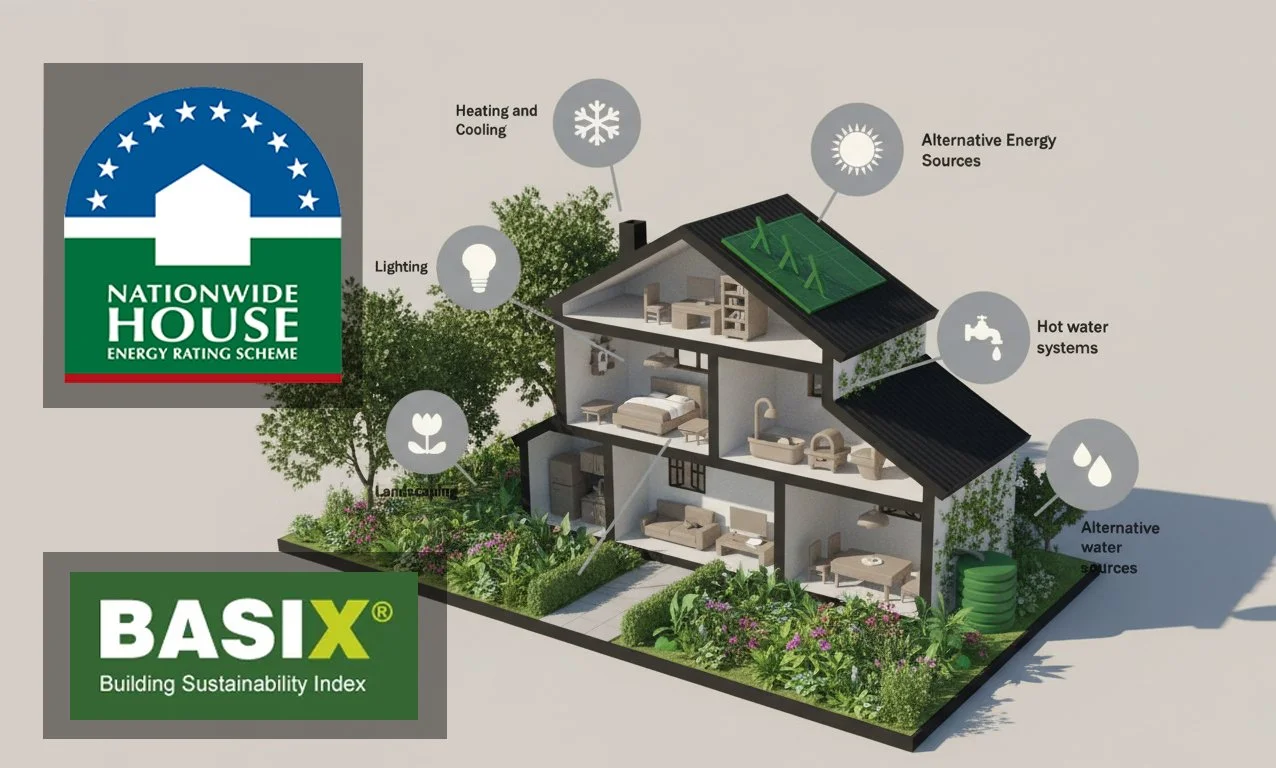
Legislative Foundations
BASIX is established under the Environmental Planning and Assessment (EP&A) Act 1979, facilitated through the Environmental Planning Instruments (EPIs) - State Environmental Planning Policy (SEPP), specifically SEPP (Sustainable Buildings) 2022 and implemented through the Environmental Planning and Assessment Regulation 2021. It is a State-wide planning requirement.
The EP&A Regulation 2021 defines the terms BASIX Building, BASIX Certificate, and BASIX development - click here for more on the definitions. Interestingly, the acronym originated under the former SEPP (Building Sustainability Index: BASIX) 2004. There is no definition of the acronym anywhere, but rather the new SEPP (Sustainable Buildings) 2022 assumes the term is already understood.
Brief History of BASIX in NSW
The Building Sustainability Index (BASIX) was introduced by the NSW Government in 2004 as a response to rising energy and water consumption in residential development. At the time, NSW was experiencing:
increasing demand for water supplies
growing household energy use
a need for more climate-responsive housing design
BASIX was designed to ensure that new homes were more efficient, more comfortable and more sustainable than the existing housing stock.
When Did BASIX Come Into Effect?
BASIX became mandatory on 1 July 2004 for:
Since its introduction, BASIX has been progressively strengthened to reflect improved building standards, climate data and government sustainability targets.
How Have the Energy Standards Changed Over Time?
Original Requirements (2004)
When BASIX was first introduced, the thermal comfort requirement was broadly equivalent to around a 3.5-4 star rating under the early NatHERS framework.
At the time, this represented a significant improvement on typical housing construction, which often had:
Current Requirements
Today, BASIX requires residential development to achieve a minimum 7-star NatHERS thermal performance rating, depending on climate zone and building type. This aligns NSW with broader national energy efficiency reforms and reflects:
improved construction practices
higher expectations around occupant comfort
increased energy costs and climate resilience
As a result, homes approved today are significantly more efficient and comfortable than those built prior to BASIX.
What Does BASIX Assess?
Energy Efficiency
heating and cooling performance
building envelope and insulation
glazing and shading
fixed appliances and lighting
Water Efficiency
Thermal Comfort
how the dwelling performs in summer and winter
reliance on artificial heating and cooling
internal comfort levels throughout the year
How Are BASIX Calculations Done?
BASIX assessments are completed using the NSW Planning Portal BASIX tool, which incorporates:
For the thermal comfort component, NatHERS-accredited software is used to model how the dwelling will perform across a full year. The BASIX Certificate then locks in mandatory commitments, which must be reflected in the approved plans and construction.
Why BASIX is Important to Get Right
BASIX commitments are:
If BASIX, NatHERS and architectural plans don’t align, it can result in:
Why Professional Coordination Matters
As BASIX requirements have become more stringent, early coordination between design, planning and sustainability assessment is critical. At WAD, BASIX and NatHERS are not treated as a tick-the-box exercise; they are coordinated with the architectural design to:
minimise unnecessary costs
avoid late-stage redesigns
keep approvals moving efficiently
avoid unforeseen building costs
What Does NatHERS Stand For and Why Do I Need One?
NatHERS stands for the Nationwide House Energy Rating Scheme. In simple terms, it’s the Australian system used to measure how energy-efficient a home is, particularly in relation to heating and cooling. You may need a NatHERS assessment when a residential development needs to demonstrate compliance with the thermal comfort and energy efficiency requirements of BASIX (falls outside the “Do-It-Yourself” assessment parameters within BASIX). In simple terms, NatHERS is used when Council or a certifier needs proof that a home will perform well in terms of heating and cooling.
NatHERS rates a home’s thermal performance on a star system from 0 to 10 stars, 0 being the worst energy efficient and 10 being the best. The assessment is based on things like:
The higher the star rating, the more comfortable and energy-efficient the home is expected to be.
When is NatHERS Assessment Required?
A NatHERS assessment is commonly required for:
New Dwellings (particularly when glazing is >30% of the floor area)
Secondary Dwellings (Granny Flats)
Dual Occupancies
Residential Flat Buildings
Major alterations or additions where the building envelope is changed
Complex designs that cannot rely on standard “deemed-to-satisfy” options
In most cases, if the proposal is a new home or a substantial residential development, a NatHERS assessment will be required to support the BASIX Certificate.